


ecoGranic®: concrete decontaminating pavement

What is ecoGranic®?
ecoGranic® is the technology developed and registered by PVT, implemented in a high-strength precast concrete that, in addition to fulfilling its architectural and aesthetic function, actively contributes to the elimination of pollutants from the atmosphere through a process similar to the chemical process used by plants.
This technology is very efficient in the elimination of nitrogen oxides (NOx), volatile organic compounds (VOCs) and particulate matter (PM). This prefabricated product is environmentally friendly. It is produced with recycled materials, among others, especially from construction and industrial sectors.
How does it work?
ecoGranic combats pollution through a process similar to the photosynthesis of the plants. It turns damaging gases into harmless compounds for human health and environment, through a natural oxidation process, chemical agents free and with an endless effect in time.
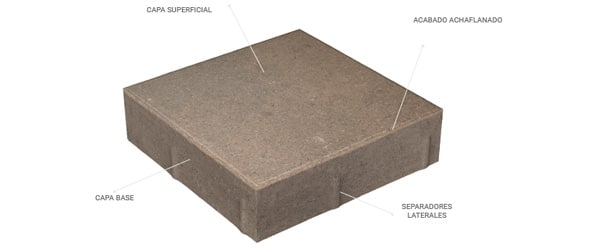
ecoGranic is made in two layers. Attending to the composition and thickness of the surface layer, it guarantees a high decontaminating efficiency during more than 25 years, in spite of the usual abrasion processes.

Certified technology
The ecoGranic® technology declares and guarantees the degradation of NOx with the endorsement of a Product Certificate, according to UNE 127197-1: 2013 standard.
How is the efficiency tested?
The different tests to which ecoGranic is subjected demonstrate high efficiency in the elimination of contaminating elements such as nitrogen oxides (NOx), volatile organic compounds (VOCs) and particulate matter (PM).
At lab scales, ecoGranic tests show a high efficiency in the elimination of NOx, VOCs and PM. In the case of nitrogeno oxides (NOx) the tests have been performed according to the European ISO 22197-1:2007 and Spanish 127197-1:2013 normatives, where ecoGranic has been classified as Class 3, the highest classification.
Regarding to volatile organic compounds (VOCs), the test have been run following the standards ISO 22197-2,3,4:2007 and AFNOR XP B44-013, obtaining a high elimination power for these pollutants.
However, it is in in-situ studies, carried out in finished works, where ecoGranic shows its real efficiency. Since the first study, realized in the year 2009, hundreds of measurements have confirmed a mean reduction about 60% in NOx levels. The repetition of this tests in the works after more than 5 years, have shown the maintenance of the decontaminating function.
If the surface of a football field was paved with this product, the pollution generated by more than 4.000 vehicles per year would be eliminated.

Decontaminating power. Amount of NOx degradation
The amount of NOx degraded in 1 hour by ecoGranic in 1 m2 is 78 mg / m2 (= 0.078 g / m2)
Models and formats
PVT manufactures ecoGranic® in multitude of sizes and formats of paving stones and slabs, garden pieces, curbs, steps, technical and accessibility solutions. And if you do not find what you’re looking for, we’re able to create it.
Finishes and colours
We offer a multitude of finishes for ecoGranic® products. Different textures and a wide range of colors combinable with each other. We are sure that we have the finish you are looking for for your project.

Heatlh and saving
ecoGranic use has important benefits for health and the environment, and the consequent savings in public health.

BREEAM and LEED certifications

BREEAM points
ecoGranic® has a Solar Reflectance Index (IRS) of between 33 and 66 (depending on the color), thus avoiding the absorption of heat.
ecoDraining® from the ecoGranic® range is highly draining allowing the construction of rainwater collection systems for later consumption as non-potable water.
ecoGranic® has a recycled content of up to 30%, thus reducing the impacts resulting from the extraction and processing of raw materials. All raw materials used for production, as well as manufacturing, are made in Spain.
All raw materials used for production have been extracted legally and conveniently, and have their corresponding certification.
The ecoGranic® products are Applus certified, which indicates the ability to reduce NOx levels in the atmosphere with class 3 (maximum classification in the standard).
ecoGranic® is a pioneer in the market since it includes catalysts and photocatalysts that are capable of degrading different atmospheric pollutants, both in indoor and outdoor environments.

LEED points:
The draining properties of ecoDraining® products allow the construction of rainwater collection and recirculation systems, which after being filtered, can be used in watering gardens.
All material is national.
ecoGranic® is able to reduce the content of Volatile Organic Compounds (VOCs) in indoor environments, favoring air quality.
Advantages of ecoGranic compared to other pavements
Techniques
Advantages over continuous pavements
The ease of replacement and maintenance make ecoGranic a very suitable pavement for our cities, where most of the services always go along the sidewalks. In addition, it offers excellent architectural and aesthetic alternatives.
Advantages over ceramic pavements
The dimensional uniformity and its greater range of sizes and thicknesses make ecoGranic an ideal flooring for all uses, whether pedestrian, mixed or road.
Advantages over natural pavements
ecoGranic offers multiple solutions of colors and finishes with high anti-slip performance and very good resistance to adverse weather conditions. All this for lower costs of both acquisition and installation, and erosion of the planet.
Environmental
Advantages compared to pavements with photocatalytic cement
ecoGranic technology is not based on additive cements, but is a formula that is incorporated into the top layer of 7 to 12 mm thick tiles and guarantees maximum and permanent effectiveness. On the other hand, products manufactured with additive cements cannot guarantee their decontaminating capacity since cement is a fundamental element of concrete, and its dosage is defined and cannot be modified to achieve the desired decontaminating capacity. In addition, the prices of photocatalytic cements are very high, so their use would force them to be priced out of the market or reduce their dosage and therefore their effectiveness.
Advantages compared to pavements with commercial TiO2
ecoGranic uses catalysts that, properly synthesized by doping, manage to amplify the effect of solar radiation. Commercial TiO2 is activated by UV radiation (<420 nm, 5% of solar radiation), while ecoGranic® products are activated by UV and visible radiation (420-740 nm, 45% of solar radiation).
Advantages over spray or photocatalytic primers
ecoGranic is part of the piece. On the contrary, in sprays or primers, the decontaminating duration in time is very limited. Pavements are subjected to regular processes of erosion and abrasion due to pedestrian traffic, traffic, etc. Said wear eliminates in a short time any film with photocatalytic properties applied to the pavement.
Frequently asked questions
If you still have doubts, consult our FAQs about ecoGranic
How long does its effect last?
Thanks to the thickness of its active layer, between 7 and 12 mm, ecoGranic guarantees its decontaminating activity for more than 25 years, despite the usual abrasion processes.
Are all colors equally effective?
All ecoGranic pieces offer decontaminating activity, although those manufactured in light tones are more effective.
Are there contraindications in the use of ecoGranic®?
No. The controls and tests to which they are subjected show that far from having any adverse effect, they offer even better mechanical performance than traditional pavements.
What means exist to verify its effectiveness?
At the laboratory level, there are the European ISO 22197-1:2007 and Spanish UNE 127197-1:2013 standards, which allow tests to measure the degradation of nitrogen oxides (NOx). At the same time, PVT offers the possibility of carrying out tests in situ after the execution of each work.
What is the cost of ecoGranic®?
ecoGranic has a variable price depending on the models, formats, thicknesses and finishes, which is in line with quality flooring.